
Fight With Knowledge Not Fear
Mammograms Alone Can Miss Up to 50% of Small Tumors in Dense Breasts
Dense breast tissue hides cancer. If you have dense breasts, mammography alone is NOT enough.
But most women are never told this, and:
Carrie Lyn Cares is changing that. Negotiating affordable pricing, expanding access, and helping women get the screening they need.
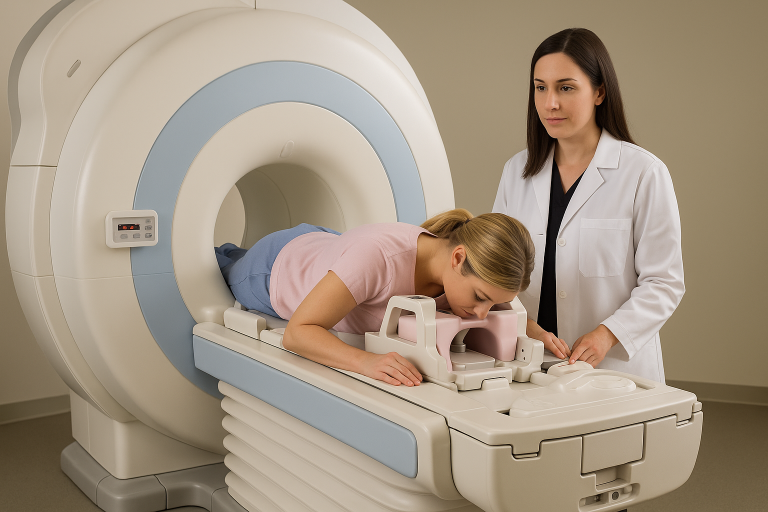
What an Abbreviated (FAST) Breast MRI Is
An Abbreviated (FAST) Breast MRI, also called a FAST MRI, is a shorter, highly accurate breast MRI designed specifically to find cancers hidden by dense tissue.
It uses the same contrast-enhanced technology as a full diagnostic MRI, but with a shorter scan time and lower cost.
What Makes It Different:
MRI sees blood-flow patterns of tumors — so cancer cannot hide behind dense tissue.

What an Abbreviated (FAST) Breast MRI Is Not

Who Should Consider an Abbreviated (FAST) Breast MRI
Where to Get an Abbreviated (FAST) Breast MRI
Carrie’s Story Is Why This Matters
Carrie Lyn had heterogeneously dense (Category C) breast tissue. Her tumors grew silently behind dense tissue — all while her mammograms repeatedly said “no suspicious findings” and “no signs of malignancy.”
Dense tissue masked the cancer until she found it herself.
By then, it was advanced.
This happens to thousands of women every year.
Read more about Carrie
How to Tell If You Have Dense Breasts
(Even If Your Clinic Uses Outdated Terms)
Most women are never told their true breast density.
Mammogram letters usually only say:
But breast density has four categories, and knowing yours matters, because mammography fails most often in Categories C and D.
| Category | Description | Key Notes |
|---|---|---|
| A | Almost entirely fatty | Least dense, easiest to detect cancer on mammograms. Mammograms work very well here. |
| B | Scattered areas of fibroglandular tissue | Slightly higher risk than A. Cancer may be mildly masked. Mammograms still work well. |
| C | Heterogeneously dense | Tumors are harder to detect; risk is notably higher. Mammograms can miss up to 45 percent of cancers. |
| D | Extremely dense | Highest risk category. Mammograms can miss up to 60 percent of cancers. |
If your report says C or D, you have dense breasts — and mammography alone is NOT enough.
Older Terms You Might See
(Especially in Rural or Outdated Systems)
If your report uses any of these terms, you have dense breasts:
They all mean the same thing: your tissue is dense.
Some clinics still reference the Gail Model, an older risk calculator that does not measure breast density.
If your report mentions GAIL, ignore the score and look for the density trigger words above.
If your report mentions C, D, or any density-related terms, you have dense breasts, and you need supplemental screening.
The New Federal Dense Breast Notification Rule
As of September 10, 2024, imaging centers must tell women whether their breasts are dense or not dense.
But these letters:
This is why supplemental screening — like Abbreviated (FAST) Breast MRI — is essential.
Your Mammogram Was Normal , But If You Have Dense Breasts, That’s Not Enough
Dense breast tissue hides cancer.
If your breasts are Category C or D:
Mammography alone is NOT enough.
Not sometimes.
Not maybe.
Not enough.
Do not rely solely on mammography.
Do not accept reassurance based only on a “normal” mammogram.
Do not let dense tissue blind your screening.
You need supplemental screening — and the most accurate option is Abbreviated (FAST) Breast MRI.
Your life is worth early detection.
Your screening should be too.